

Do Himalayan Salt Lamps Eventually Melt? The Truth About Salt Lamp "Sweating"
If you have ever spotted little beads of water around the base of your glowing pink lamp, you have probably asked the question that worries every new owner: do Himalayan salt lamps eventually melt? It is one of the most common concerns we hear at Q&A Himalayan Salt, and the short answer may surprise you. Your lamp is not dissolving into a puddle, and it is not defective. What you are seeing is a completely natural property of pure Himalayan rock salt. In this guide we will explain exactly what is happening, why it occurs, whether your lamp can ever truly disappear, and the simple steps that keep it glowing beautifully for years.

The Short Answer: No, Your Salt Lamp Will Not Melt
Himalayan salt lamps do not melt the way ice or wax does. Melting requires heat to turn a solid into a liquid, but that is not what is happening here. Instead, your lamp may "sweat," "weep," or "cry" — terms used to describe moisture that gathers on the surface and sometimes pools at the base. This happens because salt naturally pulls water out of the surrounding air. The crystal itself stays solid and intact. Unless you submerged your lamp in a bucket of water for days, it will not turn into a pool of salt water.
What Is Really Happening: The Science of Hygroscopy
Himalayan salt is made almost entirely of sodium chloride, the same compound as the table salt in your kitchen. Salt is hygroscopic, which is a scientific way of saying it attracts and holds water molecules from the air. You have already seen this in action: think of how table salt clumps together in a humid kitchen or near a steaming kettle. Your lamp does the exact same thing, just on a larger and more visible scale.
Why Salt Attracts Water
At a molecular level, the salt crystal is held together by positively charged sodium ions and negatively charged chloride ions. Water molecules are slightly polarized, with a positive end and a negative end. Those opposite charges attract one another, so water vapor in the air is naturally drawn to the surface of the salt. When enough collects, it becomes visible as droplets. According to health resources like WebMD, this sweating is most likely to happen when a lamp has been switched off for a long time, because there is no heat to drive the moisture away.
Sweating vs. Melting — The Key Difference
This distinction matters. Melting means the solid structure breaks down permanently. Sweating means water is sitting on the surface temporarily and will evaporate once the lamp warms up again. Your salt lamp is sweating, not melting. The crystal is not being destroyed — it simply gets damp and then dries out, over and over, with no real loss to its shape or weight in normal conditions.
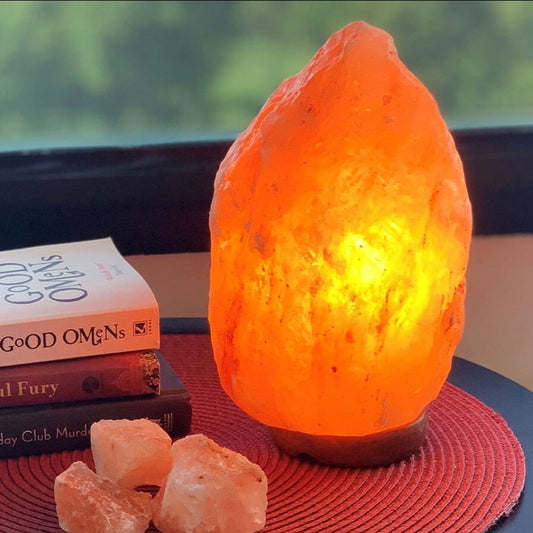
Why Does My Himalayan Salt Lamp Look Like It Is Melting?
If your lamp seems wetter than usual, one of these everyday factors is almost always the cause.
1. High Humidity
Humidity is by far the biggest factor. The more moisture there is in the air, the more your salt lamp will absorb. During rainy seasons, summer humidity, or in homes without air conditioning, your lamp has far more water vapor to pull in, which leads to visible droplets and pooling at the base.
2. Leaving the Lamp Switched Off
A salt lamp that is turned on stays gently warm, and that warmth continuously evaporates incoming moisture. When the lamp is off for hours or days, there is nothing to counteract the humidity, so water builds up. If you notice sweating, it is often a sign your lamp has simply been left off for too long.
3. Poor Placement
Where you put your lamp makes a huge difference. Bathrooms, kitchens, laundry rooms, basements, and spots near open windows are all high-moisture zones. Placing a salt lamp in these areas almost guarantees more sweating.
4. Seasonal and Climate Factors
Living near the coast, a lake, or in a tropical climate means the air around you carries more moisture year-round. Moving the lamp from a cold room into a warm one can also cause temporary condensation, similar to dew forming on a cold glass.
Can a Salt Lamp Ever Actually Dissolve Completely?
In theory, yes — but only under extreme, unrealistic conditions. If you left your lamp permanently soaking wet in a very humid space with no light or heat ever applied, the salt could slowly erode over a very long period. In a normal home where the lamp is used regularly and kept reasonably dry, this essentially never happens. The combination of routine use and the bulb's warmth keeps the crystal stable for years. So while salt is technically water-soluble, your lamp is in no danger of vanishing on your shelf.
Is a Sweating Salt Lamp a Sign of a Fake?
This is one of the most reassuring facts for new owners: sweating is actually a sign that your lamp is real. Because genuine Himalayan salt is naturally hygroscopic, an authentic lamp will collect moisture in humid conditions. A lamp that never sweats at all, no matter the humidity, may be made from a fake or coated material. So if your lamp occasionally weeps, take it as proof you bought the genuine article. Every lamp from Q&A Himalayan Salt is guaranteed 100% authentic, hand-carved rock salt.
How to Stop Your Himalayan Salt Lamp From "Melting"
You cannot change the nature of salt, but you can easily manage the moisture. Follow these proven care tips to keep your lamp dry, glowing, and long-lasting.
- Keep it switched on. This is the single most effective tip. Running your lamp 16–24 hours a day keeps the crystal warm and continuously evaporates moisture. Salt lamp bulbs use very little electricity, so the cost is minimal.
- Use the correct bulb. A bulb that produces enough gentle heat is essential. An underpowered or LED-only bulb may not warm the crystal sufficiently to dry it out.
- Choose a dry location. Place your lamp in a living room, bedroom, or office with good airflow. Avoid bathrooms, kitchens, basements, and windowsills.
- Protect your furniture. Set the lamp on a coaster, ceramic plate, or wooden tray to catch any droplets and protect the surface beneath it.
- Wipe gently when needed. If moisture appears, switch the lamp off and blot it with a soft, lint-free cloth. Do not rub hard or use a soaking-wet cloth, as that will dissolve the surface.
- Run a dehumidifier. In very damp rooms or climates, a dehumidifier dramatically reduces sweating.
- Store it correctly. If you are putting the lamp away for a season, unplug it and wrap it in a plastic bag or sealed container to block moisture absorption.

How Long Do Himalayan Salt Lamps Last?
With basic care, a genuine Himalayan salt lamp can last for many years — even decades. The salt crystal itself does not wear out or expire. The only part you will ever replace is the small light bulb inside. Because the lamp formed over roughly 250 million years deep in the earth, the crystal is remarkably durable. Treat it well, keep it dry and lit, and it will keep glowing far longer than most home decor items you own.
When Should You Actually Be Concerned?
A little sweating is normal, but you should take action if you notice persistent pooling that damages furniture, electrical components getting wet, or the cord and bulb fitting becoming damp. In those cases, switch the lamp off at the wall for safety, dry everything thoroughly, and move the lamp to a drier spot. If the wiring or fitting is ever wet, stop using it until it is completely dry to avoid any risk of a short circuit. These are easy precautions, not signs that your lamp is failing.
Final Thoughts
So, do Himalayan salt lamps eventually melt? No — they sweat, and that is a natural, harmless, and even reassuring property of authentic rock salt. Your lamp absorbs moisture from humid air, and the bulb's warmth releases it again. By keeping your lamp switched on, placing it in a dry spot, and giving it the occasional gentle wipe, you will enjoy its calming amber glow for years to come. Embrace the sweat as proof you own the real thing.
Ready to Bring Home the Real Glow?
Explore our collection of 100% authentic, hand-carved Himalayan salt lamps — with free shipping from our Pennsylvania warehouse.
Shop Salt LampsFrequently Asked Questions
Do Himalayan salt lamps melt over time?
No. Himalayan salt lamps do not melt. They are hygroscopic, meaning they absorb moisture from humid air and may "sweat" or "weep," but the solid crystal stays intact. The bulb's warmth evaporates the moisture, so the lamp does not dissolve under normal use.
Why is my salt lamp leaking water?
Your salt lamp leaks water because salt naturally attracts moisture from the air. This is most common in humid environments or when the lamp has been switched off for a long time. Keeping the lamp turned on and in a dry room prevents most leaking.
Is a sweating salt lamp fake or broken?
Neither. A sweating salt lamp is actually a sign of authenticity. Genuine Himalayan rock salt is hygroscopic and collects moisture in humid conditions. A lamp that never sweats at all may be fake or coated.
How do I stop my Himalayan salt lamp from sweating?
Keep the lamp switched on for 16–24 hours a day, use the correct bulb, place it in a dry, well-ventilated room away from bathrooms and kitchens, set it on a coaster or tray, and run a dehumidifier in very damp spaces.
How long do Himalayan salt lamps last?
With proper care, a genuine Himalayan salt lamp can last for many years or even decades. The salt crystal does not expire — only the light bulb inside needs occasional replacement.
Disclaimer:
The lamp is not intended to diagnose, treat, cure, or prevent any disease. Consult your healthcare provider before starting any dietary supplements or wellness programs.
Due to the inherent nature of Himalayan Rock Salt, no two lamps are alike. Moreover, variations in size and weight are expected, making each lamp uniquely appealing.